

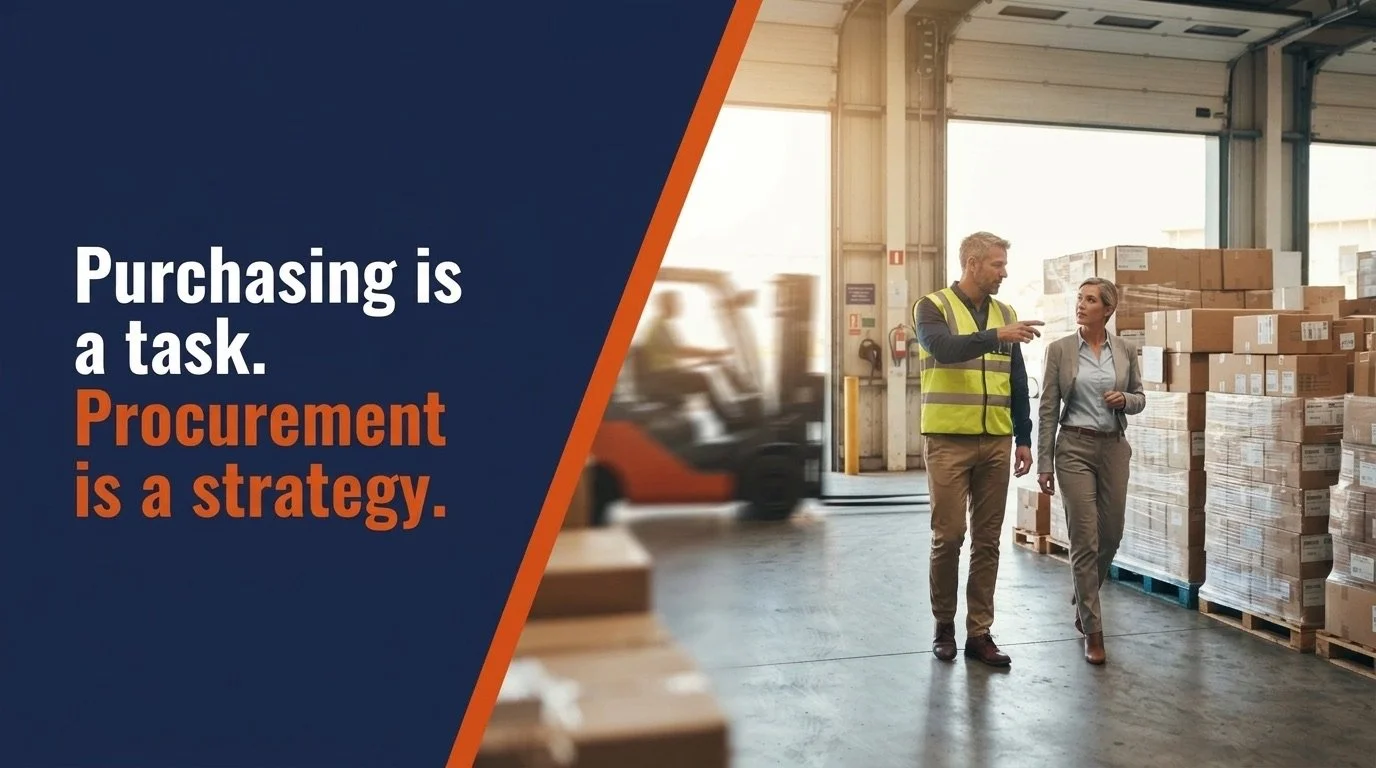
Purchasing Is a Task. Procurement Is a Strategy.
Most growing companies buy the same way they did when they were small. Someone needs something, finds a supplier and places an order. The invoice gets approved and the cycle repeats.
That works until it doesn't. As a business adds locations, crews and product lines, those small decisions multiply. Suppliers pile up. Pricing varies from one site to the next. Nobody can say with confidence what the company spends on uniforms, MRO supplies or office essentials in a year.
This is the gap between purchasing and procurement. Purchasing is the act of buying. Procurement is the discipline of deciding what to buy, from whom, on what terms and how to manage it over time. A group purchasing organization, or GPO, is one of the most practical ways for a private-sector business to close that gap without building a procurement department from scratch.
What a GPO actually does
At its core, a GPO establishes contracts with suppliers on behalf of many member organizations. Suppliers agree to strong terms because one agreement gives them access to a large, qualified group of business customers.
The contract is only the starting point. A GPO that operates as a procurement partner also helps members:
See their spend clearly. Which categories are growing, which suppliers are used and where buying is fragmented.
Build category strategies. Deciding how a category should be bought, not just who sells it.
Strengthen supplier relationships. Members gain access to established partners with dedicated support instead of starting cold.
Standardize and consolidate. Fewer suppliers and fewer SKUs usually mean simpler ordering, cleaner records and better service.
Where the value shows up
The benefits of a group purchasing organization go well beyond the line-item price. For most members, the biggest gains come from efficiency and control.
Time back for your team. Sourcing, vetting suppliers and setting up terms takes hours that operations, finance and facilities teams rarely have. When that work is already done, people can focus on running the business.
Consistency across locations. When every site orders from the same programs, the business gets the same products, the same service levels and the same terms everywhere. That matters for quality, safety and brand standards.
Visibility into indirect spend. Indirect categories like MRO, uniforms, janitorial, travel and office supplies are easy to overlook because no single purchase is large. Together, they are often one of the least managed parts of the budget. Organized programs make that spend visible and easier to plan around.
Fewer disruptions. Established supplier partners with strong service records reduce the risk of stockouts, missed deliveries and last-minute substitutions.
What this looks like in practice
TruPointe members across industries use these programs in different ways. An industrial member centralized purchasing of uniforms and other indirect categories, gaining speed and control across its operations. A poultry company standardized products and consolidated MRO suppliers, which improved service and gave leadership the visibility it needed to support growth. A fitness chain launched a custom furniture program with a supply partner, giving every location a consistent look while keeping design flexibility.
In each case, the outcome was a category that ran better, not just a lower price on an invoice.
Common questions from private-sector leaders
Isn't a GPO mainly for hospitals? Healthcare GPOs are the best known, but the model works for any industry. Private-sector GPOs focus on the categories nearly every business buys, from facility supplies to fleet and travel.
Will we have to change suppliers? Not necessarily. Many programs are with national suppliers businesses already use. When a better-fit partner is available, the decision stays with you.
Does this disrupt how we work? A good GPO fits your current processes. Members typically keep ordering the way they do today, with stronger programs behind those orders.
How is it funded? Supplier partners typically fund the GPO through an administrative fee, so members get the programs and support without a separate cost.
What to look for in a procurement partner
Not every GPO operates the same way. The strongest partners start with your data, bring depth in the categories you actually buy, help you implement and can show results in your industry.
How TruPointe approaches it
TruPointe works with private-sector organizations to move from tactical purchasing to strategic procurement. That means tailored category strategies, more than 100 supplier and category relationships and actionable insight through the TruSource analytics platform. Members average two to five contracts each, which reflects how the programs grow with the business over time.
The process starts with visibility. TruPointe helps you understand your spend, then acts as an extension of your team to design and implement a better approach, at no cost to you.
Next step: Get started with your free spend assessment and see where your procurement can work harder for your business.